How to Read the Library
There is only one book in this library — Beyond Symmetry, by Raymond K. Houston. It can never be published for two reasons: there are too many pages to feasibly print and bind, and more pages are being added all the time. So the book lives here, the only place in the world where it can grow and be read.
I am the author. Beyond Symmetry is my method of generating tessellations.
A tessellation is a pattern of one or more interlocking shapes that fit together without gaps or overlaps — like the pieces of a quilt.
All the tessellations in this library are generated from just two cells: the original cell and its mirror image (indicated by the letter “M”).
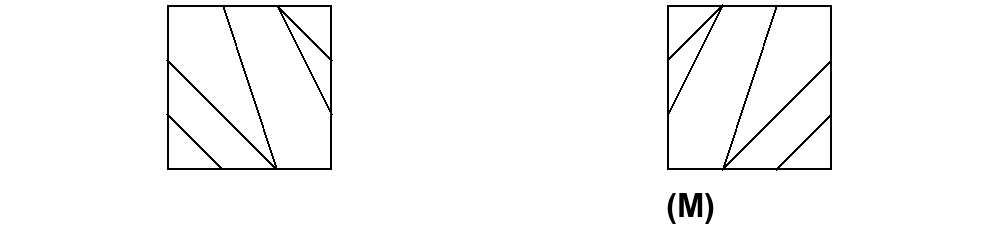
The original cell rotates clockwise in 90-degree increments; the mirror image rotates counterclockwise.
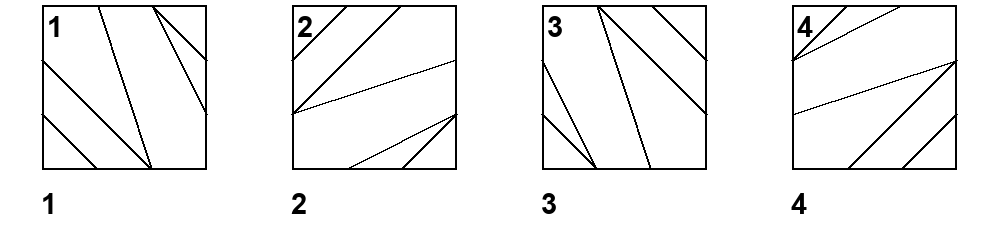
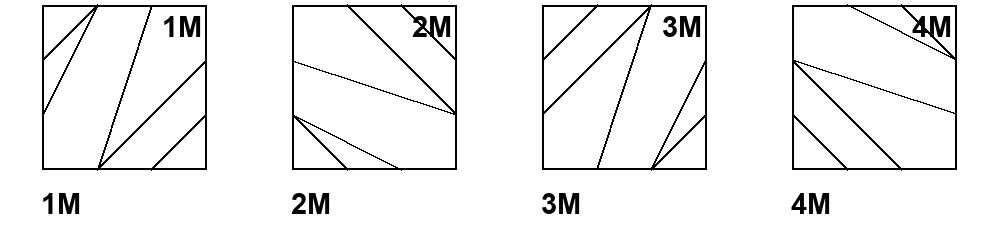
Each entry is identified by four rotation numbers — the rotations of the four cells in the upper-left corner of the tessellation. Entries are categorized by the relationship between cells (Regular or Irregular, and the action taken), and tagged by the number of shapes and their names.
You can search the library by rotation numbers, categories, or tags.
At the bottom of every entry is a link to download, print, color, and make it your own.
Before you go in, I’d like you to meet the man who started all of this.
In 2009, I wrote to Peter S. Stevens — author of Handbook of Regular Patterns, published by The MIT Press — to tell him what his book had set in motion. He wrote back, and included these words:
Forward
Symmetry assures us that whatever happens within a pattern is precisely what should happen. Because each neighborhood repeats in precisely the same way, everything shows up in its proper place. In this perfection, we find comfort.
On the other hand, identical neighborhoods can be oppressive. Predictability is nice as long as it’s not overdone. Not getting lost is nice as long as you sometimes have the opportunity to wander about not knowing where you are. Life needs more than perfection. It needs emotion and mystery, a touch of the unknown.
As Thoreau put the matter:
At the same time we are earnest to explore and learn all things, we require that all things be mysterious and unexplorable… . We need to witness our own limits transgressed, and some life pasturing freely where we never wander.
In this book, Raymond Houston tills both sides of the road. In simultaneously working with symmetry and breaking its rules, he brings life to stony ground.
Peter S. Stevens
Author of Handbook of Regular Patterns
The MIT Press